My Misdiagnostic Adventure
- LyDiA

- Jan 21, 2024
- 5 min read
Updated: Jan 29, 2024
Blog Post #2
When I was beginning to think I may be autistic, I decided the best way to know for sure was to get a psychological evaluation. This isn't entirely true.
For starters, I believed I could just walk in, answer the questions, and walk out with an accurate diagnosis a few visits later.
There are a few issues with the above. For starters (lol), I was just beginning to think I was autistic — I didn't really have a grasp on what my autism looked like/where my traits fell on the spectrum. To go along with this, it's highly recommended for adults to journal and document anything that seems important to their evaluation for a few months prior to. I did not have a journal, nor at the time did I know about this recommendation (apparently, neither did the psychologist, or at least they never said anything about it or my lack of materials).
Secondly, as I have recently learned, my mask is strongest when I am most anxious, and guess what makes me anxious: new people and new situations. I had never met this psychologist before, and I had no idea what to expect for my evaluation. My mask makes me look neurotypical; even if I'm still not sure exactly what that means or looks like, I know this. This is a big factor in why I got misdiagnosed.
Furthermore, this means I am able to ignore my discomfort with looking people in the eyes. Because I was able to hold eye contact, my psychologist thought there was no way I could be autistic. NOTE: this is very naive of the psychologist and shows they had little knowledge of masking.
Thirdly, my diagnosis was heavily based upon how I answered questions on a scale or out of 2-4 options on paper/online. This isn't inherently an issue, I think. Due to my experiences with classwork, I treated it like taking a test: I simply shut-up and filled in the boxes. I had all sorts of (autistic) thoughts about how to properly interpret and answer the questions and how some answers didn't really feel right to me. However, and this I believe is where the real problem is, the questionnaires always started with the prompt "best describes" or "to the best of your ability." This left me feeling like, despite my thoughts, I'll just answer how I can. I have a feeling that if I had expressed my thoughts, maybe by writing in the margins or verbally working them through with the psychologist (I feel like they should just do this anyway?!), I wouldn't have been misdiagnosed.
Sometimes, I wonder if the above could be a "neurotypical bias". Do the questions make more sense to neurotypical people? Is it supposed to be understood that I should have expressed my concerns? I didn't know this because it was never directly stated to me (hellooo, I'm autistic! lol).
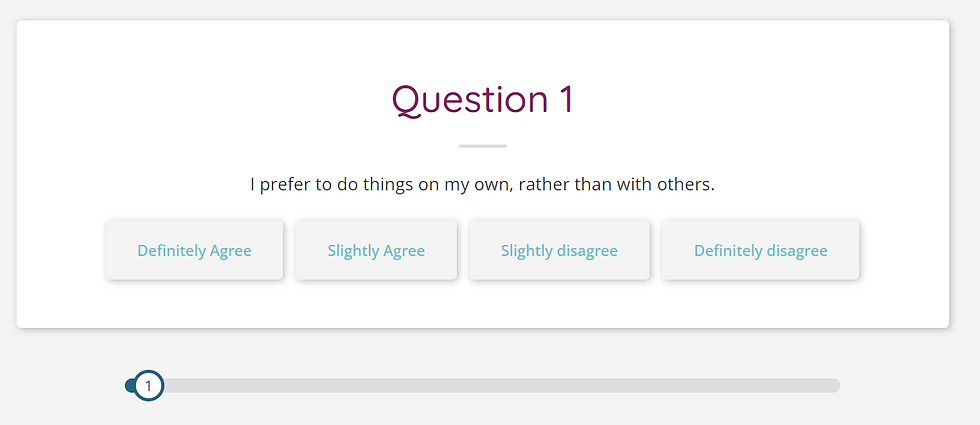
Screenshot of Clinical Partners' test.
Lastly, as mentioned in my previous post, diagnosis is only just now beginning to steer away from a bias toward white boys and beginning to accept the broader spectrum of autism. Autistic diagnosis and criteria is founded on studies on white autistic boys and men. It was even believed in the past that women couldn't even have autism. Plus, the way autism and its traits are described is through the lens of a neurotypical person describing an autistic person. All of this is to say: how an autistic woman describes herself and her autism may look nothing like how the DSM describes autism.
Now, I did have interview-like sections in addition to the questionnaires, but these were also a bit strange and very uncomfortable for me (thus, mask). Sometimes, my responses prompted the psychologist to say "say more" (and they wouldn't elaborate on exactly what they wanted from this), and I found the questions' placement odd. Furthermore, the fact that this was sometimes asked of me made me feel the same way as I did with the questionnaires: shut up and don't express your thoughts/feelings unless prompted.
The part that stands out most to me is when the psychologist asked me to describe myself, I believe specifically, in one word. I answered "countercultural," and they accepted this and moved on. There are so many ways to take this word? I wanted explain that it meant I liked rock music, I liked boy things even though I'm a girl, that I wish I could tell male friends "I love you" (and all friends really) without people thinking it was romantic, that I hated the political system and how it makes things too black and white...
But "countercultural" was accepted and the interview proceeded. Yet when I was asked the extremely absurd, yet interesting, question "how are an anchor and a fence alike," and I had to really think before saying "they hold things," I had to "say more". (An anchor holds ships down, fences hold things in like cattle) [although, thinking about it now, fences moreso block things in than hold them, lol]
Something else that caught me as strange occurred during my last meeting with the psychologist when we went over notes. They told me that I didn't pass as autistic except for during the self-evaluation and the evaluation my significant other completed, but that this didn't mean anything because these were biased. The psychologist, in other words, was trying to tell me that I wanted to be autistic.
They did this, instead of thinking, "now wait, who would know LyDiA the best? Probably herself and the person she's been living with for the past 4 years..." Instead of stepping back from their inflexible assumption that I wasn't autistic, they said that I was wrong about myself.
Even further, the psychologist couldn't even diagnose me with anything definitive. They said certainly I had anxiety and depression, so they diagnosed me with unspecified anxiety and unspecified depressive disorders. They thought I might have vulnerable narcissistic disorder.
PAUSE. Did you know, many autistic people are misinterpreted as being narcissistic?
From here, the psychologist decided they would reach out to another psychologist to discuss their notes and make final decisions before sending me the completed document.
Nothing changed. Besides the additional unspecified mood disorder.
That, and the summary paragraph changed completely. One thing I vividly remember (and my memory isn't that great so you know this was important) is a few sentences in the introduction that sounded pretty clearly like autism to me. They were something to the effect of "LyDiA was pretty calm and quiet until she was asked about something she was interested in, then she became more energetic."
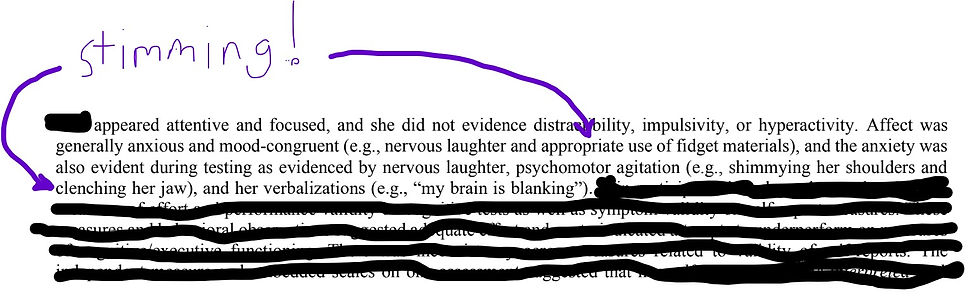
This was completely gone. Also, check out how my stimming was noted, lol!
I want to clarify before ending this post that the objective here is not to blame the psychologist. They are human as much as anyone: they make mistakes, they have to live and learn.
The psychologist I chose was very new, relatively, to their career. I had made this decision in hopes of missing the boy-bias. I think, instead, I was met with someone who worked very strictly to the books because this is all the really had to go off.
This is to say, the system is flawed.
Furthermore, funnily enough, I have a feeling they may even be autistic. When I told the psychologist I'd been eating the same lunch for the entire semester, it didn't strike them as strange; in fact, they noted then been eating the same lunch for an even longer time. They'd said "you just know what you like". Yes, I do, and so do you! wink wink.
This may even contribute to their sticking to the books, and taking from those books too literally. Not to mention their confidence in the idea that I wasn't autistic!


Comments